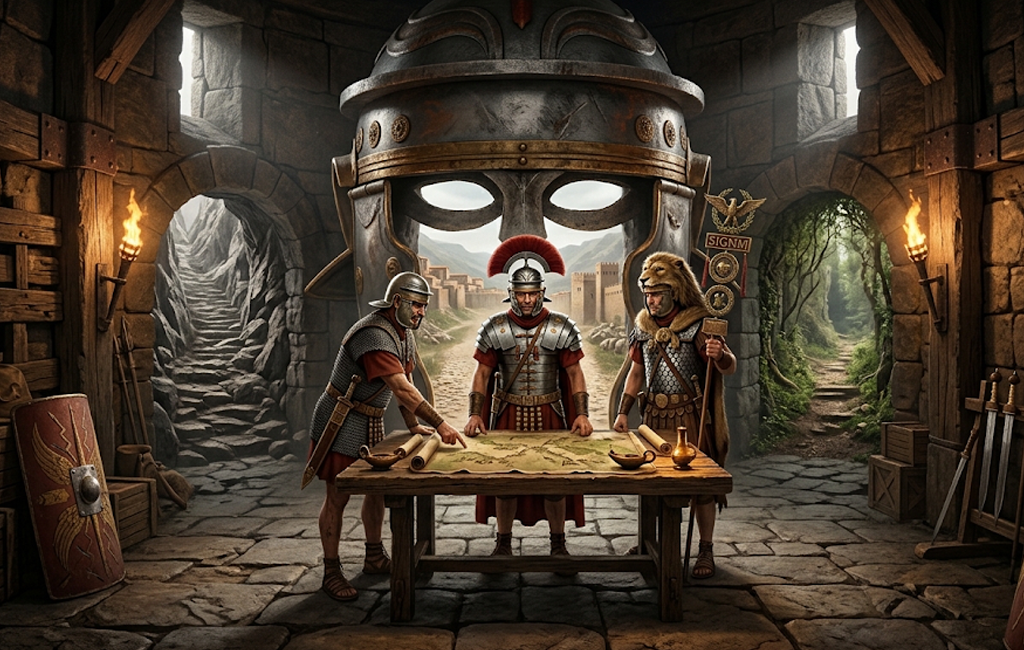
Some readers want a history lesson, and others want a sermon. A good number want both in one story. That is the appeal of Christian historical fiction, where real eras, real places, and real hardships form the backdrop for characters wrestling with belief. Instead of explaining faith from a distance, these novels show it under pressure: in a Roman barracks, on a frontier road, or in a household where owning the wrong convictions could cost a life.
This guide explains what separates the best Christian fiction books set in the past from ordinary period novels, and then offers a list of titles worth reading, starting with a trilogy that follows four Roman centurions.
What Sets Christian Historical Fiction Apart
Most historical novels use the past as scenery. In Christian historical fiction, the past also carries the argument. The author picks a time when belief mattered in a concrete way, such as the first century under Roman rule or the rough years of the American frontier, and lets the setting test what the characters say they trust.
A few traits show up again and again:
- A real period with real stakes. Persecution, slavery, war, and poverty are treated as facts, not decoration.
- Characters who change. Faith is shown as a slow turn, often after loss or failure, not a quick fix.
- Scripture woven into the plot. Many of these novels retell a Bible story or place fictional people beside a known event.
- Honest struggle. Doubt, anger, and guilt appear on the page, which keeps the stories from feeling preachy.
Why Faith and History Work So Well Together
Readers who enjoy Christian fiction books often say that history makes belief feel less abstract. When a character prays in a Roman prison or walks away from a life of violence, the choice carries weight because the setting made it costly.
History also gives faith a human scale. The people of the first century were soldiers, merchants, slaves, and officials with debts and ambitions. Seeing them as ordinary people helps readers picture how a message that changed an empire first reached someone in a marketplace or a barracks.
What to Look for in a Good Faith-Based Historical Novel
Not every one of the Christian fiction books in this category is equally strong. Before you pick one, check for a few things:
- Research that shows without lecturing. Details about food, clothing, travel, and law should appear naturally in scenes.
- Faith that grows from the characters. The best stories let belief arise from what people experience, not from speeches.
- Respect for the source material. Novels tied to Scripture should add imagination without contradicting the text.
- Moral complexity. Good and bad choices should both have consequences.
Books About Christian Historical Fiction Worth Reading
The titles below range from a recent trilogy to novels that have been read for more than a century. Together they cover the Roman world, the early church, and nineteenth-century America.
1. A Centurion Trilogy: Different Roads, Same Direction by Darrell Smith
Darrell Smith’s trilogy follows four Roman centurions whose lives take them through German forests, shipwrecks, slave markets, and finally the hill called Golgotha. One is an aging tracker who has spent fifty winters hunting and still lacks an answer to the question that shadows him. Another is a younger brother who builds his career on calculation, trusting that a saddle, a wall, a bridge, or even a person can be understood through angles, loads, and stress, until an old chieftain shows him that some things cannot be engineered, only given. A third is a shipwrecked officer who is pulled from the sea and handed responsibility for a prisoner named Paul, and who begins to see obedience and faith as close relatives. The fourth belongs to a company of soldiers keeping a watch at the foot of a hill outside Jerusalem that no training prepared them for.
Each man carries a ledger of his own: debts owed, men lost, and orders that cost more than they were worth. Each has also reached, at some point, toward an altar with no name on it, in case a God existed whom he had not yet found. The trilogy asks what they discover instead. It points to something other than a sacrifice repeated season after season: a verdict entered once and not open to appeal.
For readers who like Christian historical fiction with a military setting and a clear sense of how faith meets a hardened life, this is a strong place to begin. Its structure of four men, four roads, and one destination also suits readers who like novels that follow several lives toward a single event.
2. The Robe by Lloyd C. Douglas
A Roman tribune named Marcellus Gallio wins the robe of Jesus after the crucifixion, and the garment begins to change his life. The novel follows his search for the meaning of what he witnessed. It remains one of the best-known examples of Christian fiction books set in the first century.
3. Ben-Hur: A Tale of the Christ by Lew Wallace
Judah Ben-Hur, a young Jewish nobleman, is betrayed by a Roman friend and sent to the galleys. His story of vengeance and survival runs alongside the life of Jesus. It is a long, classic adventure with faith at its core, and a landmark among Christian fiction books.
4. Quo Vadis by Henryk Sienkiewicz
Set in Nero’s Rome, the novel follows a Roman officer, Marcus Vinicius, who falls in love with a young Christian woman named Lygia. Their story unfolds against the persecution of early believers, which makes it a clear example of the genre’s interest in cost and conviction, and a long-standing title among Christian fiction books about the early church.
5. A Voice in the Wind by Francine Rivers
The first book in the Mark of the Lion series centers on a young Jewish Christian slave living in the Roman Empire. Rivers pairs the brutality of the era with a close look at how faith shapes ordinary choices.
6. Redeeming Love by Francine Rivers
This novel moves the story of Hosea to California during the Gold Rush. A man who believes God has told him to marry a woman scarred by her past tries to show her patient love. It is a good pick for readers who want Christian historical fiction outside the ancient world.
Why This Matters: A Note on Reading Faith-Based History
Historical fiction can never replace history, and it can never replace Scripture. What it can do is give readers a way to picture the people behind the facts. When a novel is built on careful research and a faithful reading of its source material, it makes the world of the Bible and the early church easier to understand and harder to forget.
A few cautions help. Read the author’s notes if they are included, since they often separate documented events from invented ones. Treat the dialogue and inner thoughts of historical figures as imagination. And if a story raises questions about the actual events, a good study Bible or a trustworthy history is the next step. Used this way, Christian fiction books work as an entry point, not a final word.
Conclusion
The best Christian historical fiction gives readers more than a story set in the past. It shows what belief costs and what it offers when life is at its hardest. Whether you start with Darrell Smith’s centurions, a first-century classic like The Robe, or a frontier retelling like Redeeming Love, you will find characters who face real pressure and make choices that matter. Pick one of the Christian fiction books above that matches the era you are curious about, and let the setting do some of the work.